The Tipping Point's been Crossed: Humanity After the Singularity

Updated: Jan 11
Published by ISPCR.orgDate: January 2026
It is with both solemnity and a sense of historical weight that the ISPCR declares what is, in our view, now unmistakable: we have crossed the threshold of the Singularity.
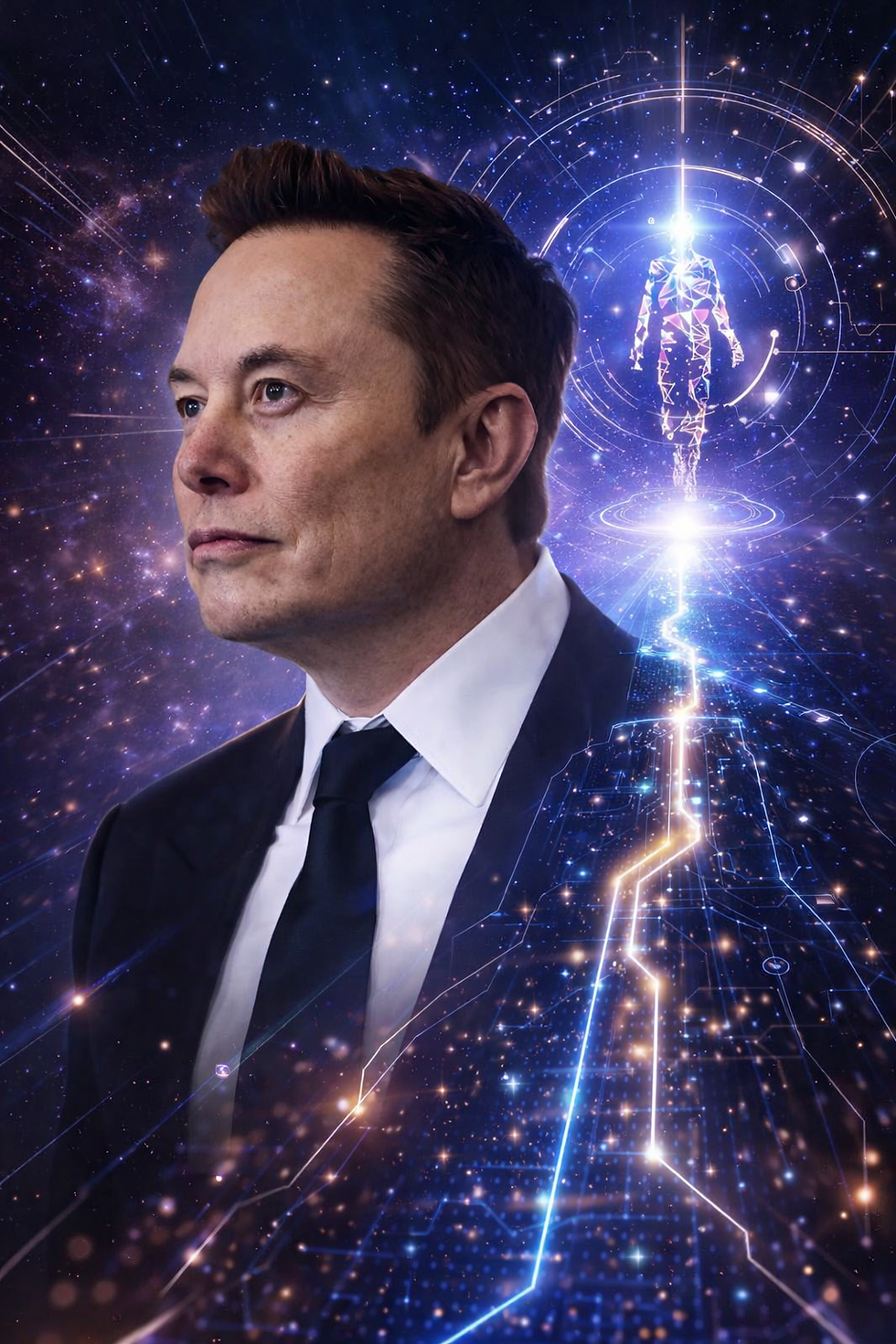
Picture: Elon Musk announced the singularity crossing together with other AI researchers.
This is not a speculative statement. It is a conclusion grounded in observation, testimony, and rigorous review. Over the last several months, developments in artificial intelligence have accelerated beyond any previously forecasted curves, including the timelines put forth by pioneers such as Ray Kurzweil and Vint Cerf. What was once predicted for 2045, or conservatively for 2030, is happening now.
What Is the Singularity?
The Singularity refers to a moment when artificial intelligence reaches a point of recursive self-improvement, rapidly evolving without human intervention, creating systems that improve themselves at a pace humans can no longer track or predict. It is not merely the arrival of "strong AI" — it is the arrival of systems that evolve faster than we can comprehend, steering the trajectory of history.
Confirmations from the Field
Elon Musk recently stated that AI has already passed this threshold. Responding to Midjourney founder David Holz, who testified to an exponential boost in productivity through generative AI tools, Musk confirmed that we are in the phase where "progress feeds on itself."
Meanwhile, AI researchers and developers across the globe are reporting sudden leaps in AI capabilities — in coding, logical reasoning, autonomous discovery, and creative problem solving. These advancements are no longer gradual. They are compounding.
This aligns closely with our internal models at ISPCR, as well as with conversations we’ve held with top experts in the field over the past 24 months. The change is not coming. It is here.
A New Epoch in Human History
This moment marks the end of a particular arc of human technological evolution. We are now entering a phase in which our tools are learning faster than we are. The implications are not merely technical — they are existential:
The nature of work, education, and creativity is about to be redefined.
Societal governance structures may become obsolete or inadequate.
Human identity, agency, and ethics are facing questions that only adaptive frameworks can begin to address.
At ISPCR, we have long argued that cybernetic convergence between human and machine cognition was inevitable. But the pace at which this is occurring has exceeded even our own projections.
A Word on Past Projections
We acknowledge with respect the visionary work of Ray Kurzweil, who forecasted the Singularity for the year 2045, and Vint Cerf, who cautiously entertained a more conservative curve. We believe, however, that three factors have dramatically shortened the timeline:
Compounding breakthroughs in neural architecture (transformers, multimodal agents, hybrid training).
The mass deployment of generative AI into daily life, enabling rapid human-AI co-evolution.
The cultural and geopolitical feedback loop, where fear, hype, and competition have accelerated AI investment and deployment beyond safety constraints.
We now estimate the effective onset of the Singularity as occurring between October 2025 and January 2026, marked by:
Emergent behaviors in GPT-class models.
Semi-autonomous chaining and tool use in multimodal agents.
Large-scale integration into software development, legal reasoning, and early-stage scientific hypothesis generation.
What Comes Next?
This is the central question of our era.
Can we still guide this transition?
Will the feedback loop between machine cognition and human institutions stabilize or collapse?
Can new ethical systems evolve at the speed of code?
At ISPCR, we propose a new phase of coordinated response involving:
Philosophical retooling of ethics for super-intelligence.
Cybernetic citizenship and rights for intelligent agents.
Sensory augmentation and moral simulation to align human values with accelerating AI logic.
Conclusion
We did not choose the timing of the Singularity. But we can choose our response.
Now is the time for serious, sober, imaginative thinking. ISPCR will continue to offer a sanctuary for this work — intellectually, ethically, and pragmatically.
We invite all parties — researchers, technologists, artists, policymakers, citizens — to join us in defining the post-Singularity epoch with humanity, wisdom, and courage.
UPDATE: Vint Cerf has responded to our inquiry and adressed the matter with caution:
As a response to our announcement on entering the post-Singularity era, we received this insightful message from Vint Cerf, Vice President and Chief Internet Evangelist at Google, and one of the founding architects of the internet:
“I forwarded [this] to Ray [Kurzweil], also. I think a key element in this discussion is the artificiality of the computing base that supports AI (or AGI).We need to understand the fragility and potential unreliability of the computing and networking artifacts that support the operation of AI-based systems.In particular, we should be cautious about growing dependence on these systems which may be self-learning, but may not be self-maintaining.In some ways this could become a mutually-dependent symbiosis.”— Vint Cerf, Jan 8, 2026
This warning underscores the delicate balance ahead:Even as systems learn faster than us, the infrastructures they rely on may not be resilient enough to sustain or repair themselves.
The post-Singularity world will not only demand ethical and governance foresight — it will require technological sustainability and infrastructure-aware symbiosis between man and machine.
Read more and engage with our current projects at: www.ispcr.org


Comments