ISPCR: A Manifesto - From Observation to Civic Action in the Age of Artificial Intelligence

Updated: Jun 13
Over the past months, several seemingly unrelated events have converged toward the same conclusion.
Artificial Intelligence is no longer a laboratory curiosity.
It is becoming a civilizational force.
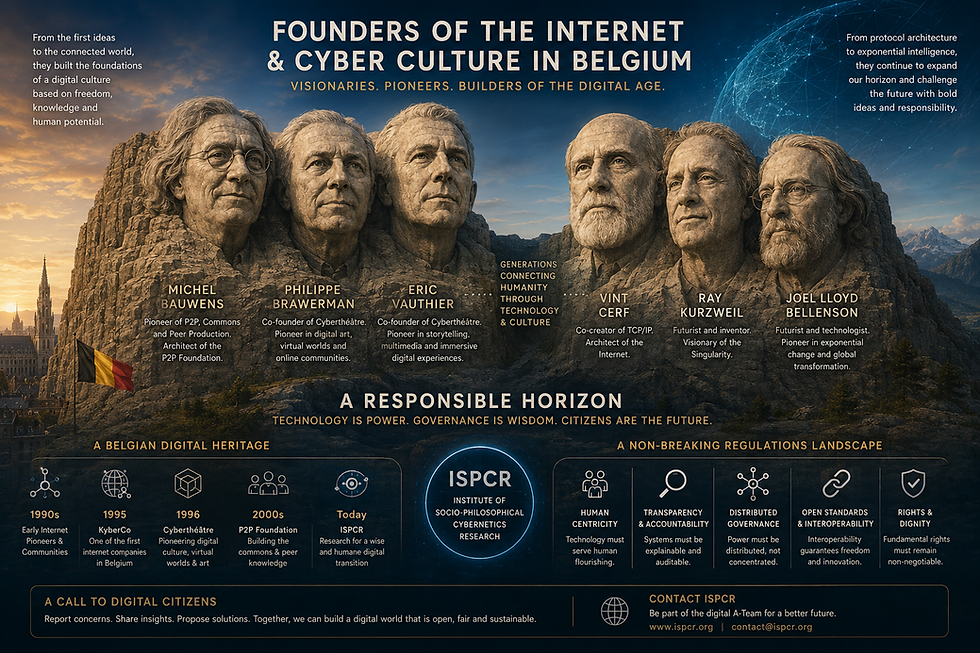
Editorial Note: This image was generated using AI as a symbolic representation of historical figures and ideas associated with Belgian cyberculture, commons governance, and Internet history. Facial features and appearances are approximate artistic interpretations.
Its influence is now visible in education, governance, entrepreneurship, public discourse, cultural life, scientific production, and everyday decision-making.
As this acceleration continues, a question naturally emerges:
Who helps citizens, organizations and communities navigate these transformations responsibly?
This question sits at the heart of the mission of the Institute of Socio-Philosophical Cybernetics Research (ISPCR).
ISPCR was not founded to celebrate technology, nor to oppose it.
It was founded to study the interaction between humans, systems, institutions and emerging technologies, and to help transform observation into responsible action.
Recent events have reinforced this conviction.
First, our work on the societal implications of AI orchestration and governance has entered the public intellectual commons through publication and archival within the Peer-to-Peer Foundation ecosystem, thanks to the engagement of Michel Bauwens and the P2P Foundation community.
This is not merely a publication event - it is reviewable here.
It represents the entry of these questions into a broader conversation about commons governance, distributed coordination, peer production and institutional evolution.
Second, ISPCR has continued to explore long-term questions surrounding technological acceleration and the possibility of a singularity horizon.
Whether one agrees or disagrees with such forecasts, the essential issue is not prediction itself, but preparedness. Ray Kurtzweil through Vint Cerf have aligned themselves - here.
The future will arrive regardless of our certainty.
The responsibility of research is therefore not to proclaim inevitabilities, but to improve society’s capacity to respond intelligently to uncertainty.
Third, recent local events have reminded us that digital citizenship is not an abstract concept. The use case was the directory of the local artists, artisans, and associations of Rebecq - available here.
Constructive engagement, correction of misunderstandings, responsible dialogue and respect for diverse communities remain essential foundations of healthy societies.
Whether the issue concerns technology, culture, identity, discrimination, antisemitism, misinformation or public governance, the digital sphere increasingly acts as an extension of civic life itself.
For ISPCR, these three domains are not separate. But valuable use-cases...
As manifestations of the same challenge:
How do human beings remain capable of self-governance in increasingly complex technological environments? Here, too our work is now actively referenced: (ex: Publication of research exploring AI-augmented governance, cybernetic coordination, and responsible decision-making - our draft: here).
Our answer is not to centralize authority.
Our answer is to strengthen literacy, dialogue, transparency and responsible experimentation.
This is why ISPCR intends to function as an open observatory and research platform dedicated to:
• Human-AI interaction• Governance augmentation• Cybernetics and systems thinking• Digital citizenship• Commons-based coordination• Emerging societal risks• Responsible technological transition
We do not claim to possess final answers.
We do believe that citizens, researchers, entrepreneurs, educators and institutions need places where difficult questions can be explored seriously, respectfully and publicly.
The future cannot be delegated entirely to governments, corporations or algorithms.
It must also be shaped by informed citizens.
For this reason, ISPCR invites individuals, organizations and communities to contact us when confronted with questions involving:
• AI governance• Digital ethics• Online conduct• Systemic risk• Community coordination• Technological transition• Citizen-level innovation
Our ambition is modest but important:
to help transform confusion into understanding,
understanding into dialogue,
and dialogue into responsible action.
The internet transformed the world.
Artificial intelligence is transforming it again.
The question is no longer whether society will change.
The question is whether citizens will participate consciously in that change.
That is the challenge ISPCR chooses to address.
— Institute of Socio-Philosophical Cybernetics Research (ISPCR)
Post-Note: “The origins of this work can be traced back to the early Belgian internet ecosystem, including experiences within KyberCo and subsequent experiments in digital culture - as of CyberTheatre Avenue - , online communities and knowledge systems.” - With Michel Bauwens, Philippe Brauwerman, and Eric Vauthier (and associated teams)


Comments